
Material Notes / Species & Origins
Why American Black Walnut Veneer Can Have a Pale Edge
Imagine four walnut cabinet doors beneath a pale stone counter. On the first three, the grain rises in dark arches. On the fourth, a cream-coloured strip meets the joint beside the handle. From across the room that strip looks almost as wide as a fifth door. At arm’s length it occupies only a small part of one veneer leaf. Its position matters as much as its width.
American black walnut veneer offers a way to work with this contrast. The tree can produce pale sapwood beside much darker heartwood, and slicing reveals the boundary in different places on successive leaves. A designer who knows where the colour comes from can choose to feature a pale edge, give it a quieter position or ask for a different set of faces. [1] [2]
Where American black walnut grows
The botanical name is Juglans nigra. The US Forest Service also records the names eastern black walnut and American walnut. Its native range covers much of the central and eastern United States and reaches southern Ontario in Canada. Within that broad area the tree often occurs singly or in small groups among other hardwoods. Well-drained bottomlands and sheltered coves in the Midwest and Appalachians are among its favourable sites. [1]
That geography helps interpret a material schedule. If an architect writes “American black walnut” beside a cabinet elevation, the phrase can identify the intended species. If the client also requires timber harvested in a particular state, the mill or supplier needs to connect that claim to the offered lot. The log may have been grown in one place, sliced in another and pressed onto panels somewhere else. Each of those locations answers a different question.
Reading the light band at the edge of a leaf
Sapwood occupies the outer part of the stem. In American black walnut it is typically creamy white. Farther in, heartwood ranges from light brown to deep chocolate brown and can carry darker streaks. Grain is often fairly straight, although some wood shows waves or curls. A strip of pale colour at the edge of a known walnut leaf is therefore quite plausible. For an unidentified or already coloured sample, ask how it was prepared before naming the band. [2]
At the cabinet, try moving the same leaf on a paper elevation. Put the pale edge beside the outer end panel and it can frame the whole run. Move it a few centimetres inward and it may pick out a single door. Repeat a similar edge at every joint and the fronts acquire a striped rhythm. These are three quite different designs that a small square of dark heartwood alone cannot show.
How slicing changes the scale of the drawing
A crown-cut or flat-cut veneer face can show nested arches where the plane of the slice passes tangentially through the annual rings. A quarter cut meets the rings at a steeper angle and tends to give a straighter pattern. That distinction is useful when the same wood is being considered for a broad pivot door and for the narrow strips beside it. Both the shape of the figure and the width available to show it will affect what is visible. [3]
A full crown might fit comfortably on the door but leave only a diagonal fragment on a narrow return. Before committing to a layout, place two paper windows cut to the actual face widths over a photograph of the available leaves at a known scale. Move the windows together as they would sit in the room. This makes it possible to see whether the wide face carries the main arch and whether the narrow face finishes its movement or appears to start a second one.
A dark walnut study under side lighting
A shadow can make a dark veneer look even more uniform in a photograph than it does in the room. Set a face sample where light will travel across it, then turn it through ninety degrees. Look for the point at which the outline of a crown remains legible while finer lines disappear. On a reception wall, that transition can determine whether a visitor notices broad arches from the entrance or only discovers the figure while standing at the desk.
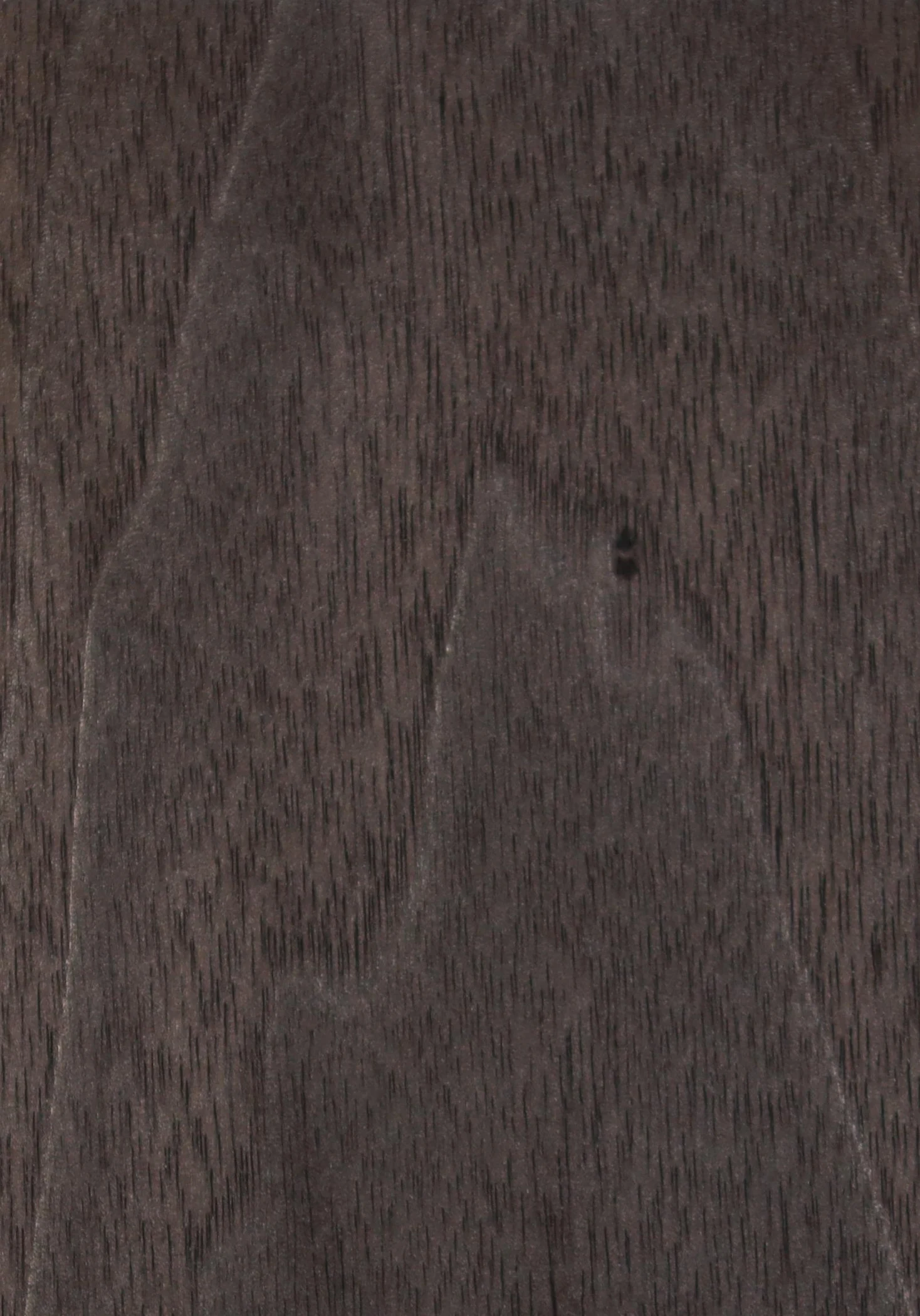
KOSEE lists Smoked Crown Walnut as a flat-cut, crown-grain material in its smoked collection. In its product image the arch near the middle is close in tone to the surrounding field. It is a useful starting point for a dark interior finish where the silhouette of the grain matters more than a dramatic change of colour. The sample illustrates a processed appearance. A buyer specifying Juglans nigra from a particular region would still request the species and origin records for the proposed batch. [4]
The same crown outline in a pale colour
For a lighter palette, ask first whether the design calls for a pale ribbon in otherwise brown wood or a pale face from edge to edge. Those briefs produce very different sample requests. AHEC notes that some producers steam walnut to darken its sapwood and reduce the contrast with the heartwood. A designer interested in a strong pale edge should therefore ask what treatment the actual material has received and see a sample that includes the boundary. [2]
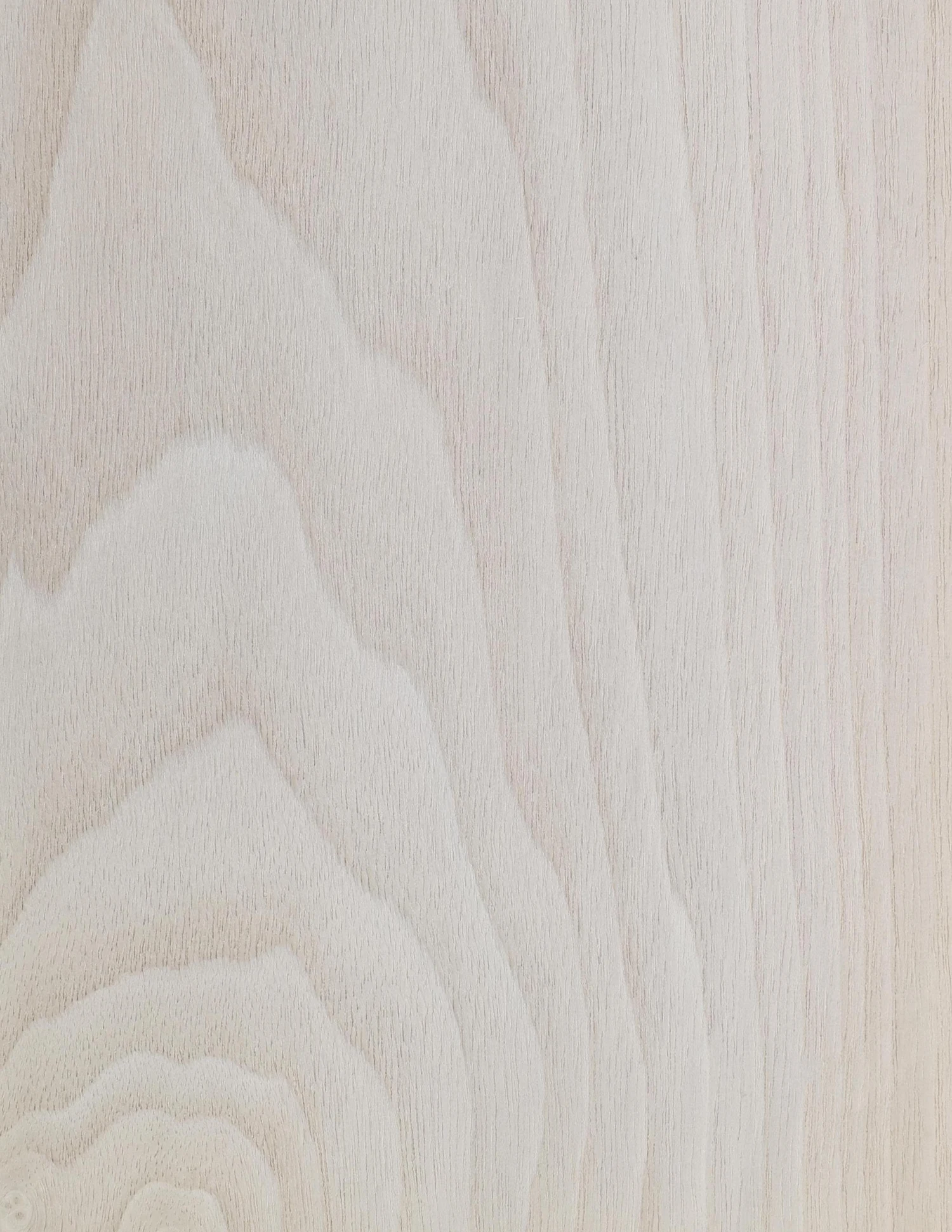
KOSEE’s dyed Crown grain Walnut in Light Pink Grey, reference 016-001, answers the second brief. Its product photograph shows a pale field crossed by a succession of soft arches. On a retail display, a paper cut-out of the shelf front held over that photo can reveal how much of an arch survives at the chosen height. A physical sample next to the merchandise lets the designer judge how the pink-grey looks beside the actual leather, fabric or metal. [5]
What to put on the cabinet elevation
Return to the four doors. Mark the handle joint, the outer ends and the normal viewing direction. Sketch where pale material is welcome and where a darker face should run uninterrupted. If the wall turns a corner, include the return in the same drawing. The cabinetmaker can then show a proposed face layout against a shared reference, and the designer can judge the whole row with the doors closed.
For a KOSEE material enquiry, send that elevation with one image of the intended colour and identify any requirement for documented species or harvest origin. Include the visible face sizes and say whether you want a light edge to repeat or to appear just once. Those details let the sample discussion begin with the feature the customer will actually see when the cabinet is installed.