Material Notes / Veneer Craft
Why White Oak Veneer Shows Crown Grain or Straight Grain
Hold two pieces of white oak veneer upright. Trace a single dark line with the tip of a pencil held just above the surface. On one leaf it rises, turns and falls. On the other it runs almost parallel to the edge. Both patterns can occur in white oak. To understand what will appear on a cabinet door, consider where the knife passed through the log and which part of the resulting leaf fits inside the door outline.
How a growth ring becomes an arch
Look first at the end of a log. Each year of growth adds a layer around the wood already there. Follow that layer along the trunk and its diameter changes along the length. When a flat slicing plane passes along the side of a log, it meets successive layers at different places. On the wide face, the boundaries can appear as nested arches, often called cathedral or crown figure. Purdue’s illustrated guide to veneer manufacture shows how that pattern changes as slicing advances through a flitch, the section of log prepared for slicing. [1]
The most revealing detail on a crown-cut leaf is often its margin. A broad arch near the middle can give way to nearly parallel lines at either side. Lay a paper strip over the peak and watch the character of the sample change. A narrow stile might show only those side lines. A wide door gives the maker room to position the peak. Before deciding how the cut will look across a room, ask to see enough width to judge both the centre and the margins.
Why straight oak grain can show fleck
Slicing closer to a radial plane, running from the centre of the tree towards its bark, generally presents the rings as straighter lines. Oak adds another visible feature. Its wood rays extend radially across the rings. A slice that runs along a broad ray can expose a light-catching patch known as ray fleck. A quarter-sliced oak face may therefore combine orderly longitudinal grain with conspicuous flecks across it. Turn the sample under the light to see where those patches interrupt the longer lines. [1] [2]
Rift slicing approaches the rays at an angle and is commonly chosen for a linear oak face with less prominent fleck. There will still be variation between leaves. If a drawing calls simply for straight grain, two suppliers might reasonably offer faces with different amounts of fleck. Describe the long lines and the acceptable fleck separately. A photograph with a marked area of acceptable figure communicates more than adding the word premium to the schedule. [2]
Place the crown before trimming the door
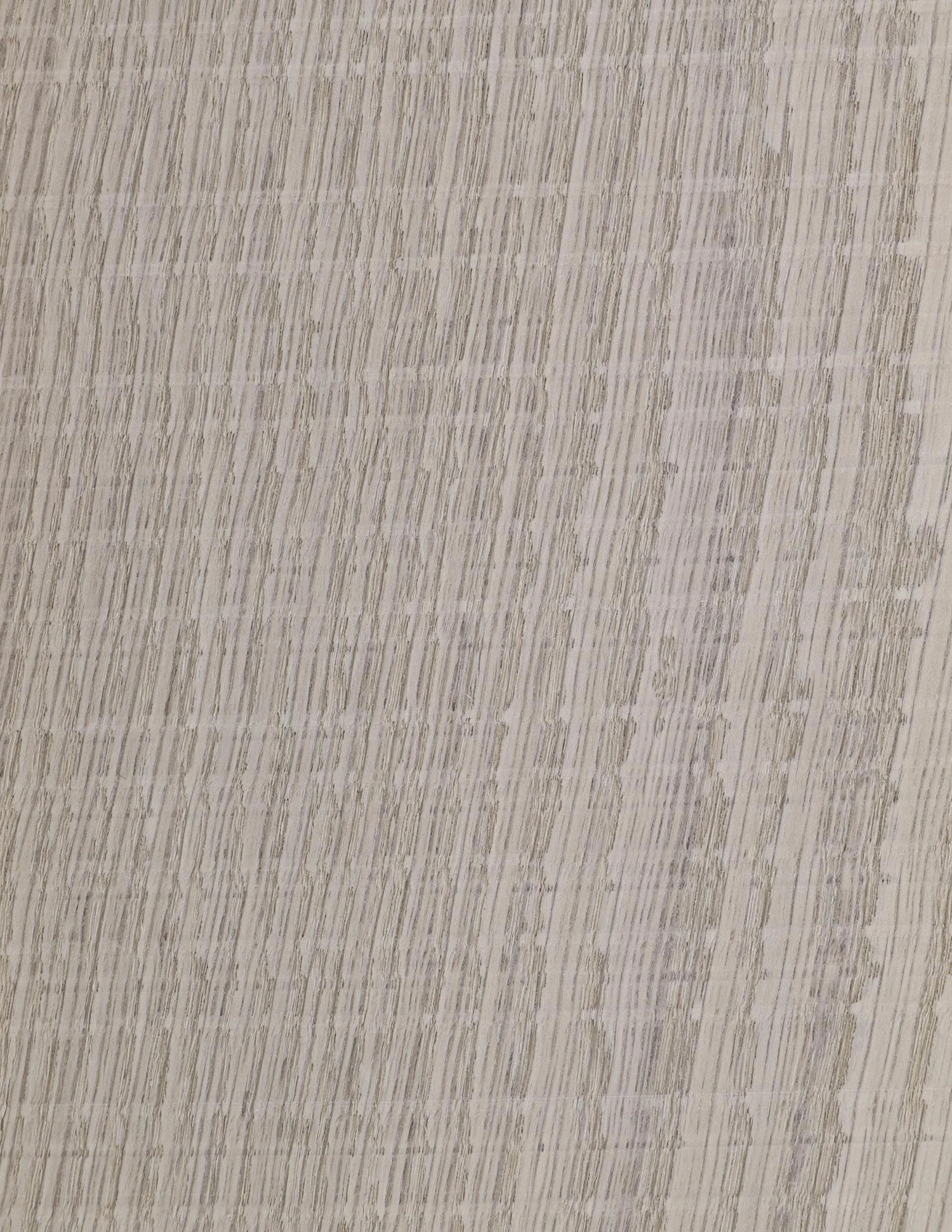
KOSEE lists grey dyed white oak 028-001 as crown grain. Use its product image as a layout exercise. Mark a cupboard door outline on tracing paper. Keeping the grain vertical, shift the outline sideways. First centre an arch. Then let it sit just inside one edge. The colour reference stays the same, yet a pair of doors cut to the second layout can look quite different when they meet at the centre gap. Choosing the reference number settles only part of the elevation. [3]
Decide which feature deserves alignment. One designer may want separate arches centred on individual doors. Another may want a single sweep to continue across a joint. Draw both solutions at the same scale and include the actual gap in each. Place the handles on the drawing. A tall pull can conceal the turn of a narrow arch. Moving the selected area on the leaf may preserve the feature without moving any hardware.

Read straight grain at installed width
KOSEE describes grey-brown dyed white oak 047-001 as straight grain with a rough, sawtooth finish. Its surface treatment introduces marks of its own. When comparing it with 028-001, follow a long line from bottom to top, then examine the shorter marks across the face. These references differ in colour and surface texture as well as figure. They are useful for discussing grain direction. To isolate cutting geometry, request faces with comparable colour and surface preparation. The catalogue description alone does not establish the knife angle for 047-001. [3] [4]
For the final review, stand two adjacent door layouts at their intended height. Look straight at the joint, then walk to the end of the run and look back. Note whether your eye follows a line, jumps between peaks or catches a fleck as the light changes. Save one close photograph and one view of both doors with the reference number, grain arrow and trim window. When requesting oak veneer from KOSEE, those marks tell the supplier which face you approved and how the workshop intends to use it.