
Material Notes / Veneer Craft
Veneer Inlay Patterns: Turning Wood Grain into Geometry
A cabinet front can read as one quiet field of wood or as a composition of arrows, squares and converging lines. The difference is not necessarily a different species. It may begin with how veneer pieces are selected, cut and arranged. Wood veneer inlay brings that relationship between the natural grain and the drawn pattern into focus.
For furniture and interior designers, the useful question is how a pattern is made, and how that process changes its appearance at room scale. This guide follows the decisions from veneer selection to an assembled decorative face, then connects them to cabinets, reception desks and brand displays. The examples are design studies for new work.
Compare KOSEE inlay patterns
-
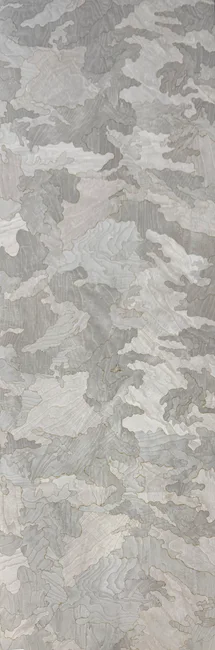 KOSEE inlay veneer18.03
Request swatch · KOSEE inlay veneer 18.03
-
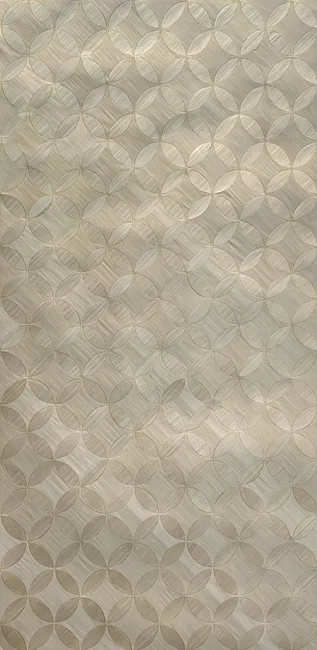 KOSEE inlay veneer18.28
Request swatch · KOSEE inlay veneer 18.28
What does veneer inlay mean?
In precise woodworking terminology, inlay inserts pieces into recesses in a base, while marquetry assembles veneer pieces into a decorative surface. The University of Melbourne's veneering manual distinguishes these constructions. KOSEE uses Inlay Veneer as a collection and development term; a project drawing should still make the intended construction clear. [1, 2]
The visual idea has a long furniture history. The V&A describes marquetry in its account of Baroque furniture as combining differently colored veneers on furniture surfaces. A contemporary interpretation can be much simpler: two grain directions, a repeated module, or one centered motif. The interest can come from the organization of the wood itself, without a complicated illustration or a large palette. [8]
1. Select the grain before drawing every joint
A geometric drawing defines the boundaries of each piece, but the veneer supplies another set of lines inside those boundaries. Decospan identifies species, slicing, joining, quality selection and finishing as contributors to the final wood appearance. For a pattern study, inspect actual leaves and decide whether the internal grain should reinforce the geometry or move more freely through it. [3]
Relatively straight grain can make the orientation of a small piece easy to read. A broad crown figure may become the main event within a larger module. Compare the size of the natural figure with the size of the proposed piece: a beautiful leaf can lose its most interesting feature if it is divided too finely. Mark promising areas on a layout before deciding the final repeat.
2. Give the pattern a direction, a rhythm or a center
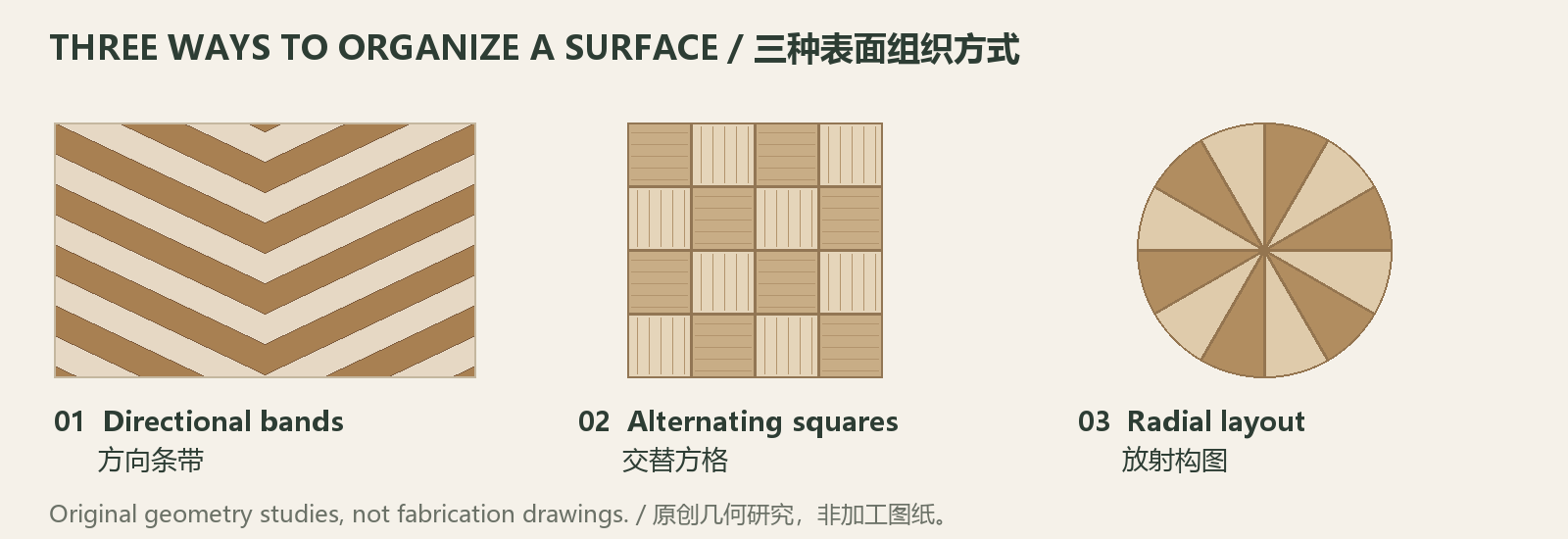
KOSEE's published pattern directions include herringbone and chevron, diamond and checkerboard, and radial or sunburst compositions. Think of these as different ways to organize a surface rather than interchangeable names for decoration. A directional band draws the eye along a cabinet; a field of repeated squares distributes attention; a radial composition establishes a focal point. These are design readings, not performance claims. [2]
The Timber Veneer Association of Australia describes sunburst matching as selected veneer brought together toward a central point. This makes the location of that point an important design choice. On a circular tabletop it may sit at the center; on a reception front, an off-center arrangement could respond to the position where a guest approaches. The latter is a design proposal, not a documented installation. [4]
Draw the pattern on the complete object before treating it as a repeatable sheet. A drawer gap may cut through the most important junction. A handle may sit exactly where several lines meet. Adjusting the module, moving the center or introducing a plain border can make the pattern work with the furniture, rather than leaving the joiner to resolve a collision at the end.
If your design calls for a pattern you can feel, compare these inlay layouts with embossed wood veneer patterns. Turn a physical swatch under side lighting to see how a raised line casts a shadow across the grain.
3. Cut and assemble the decorative face
The veneering manual describes marquetry faces as small veneer segments cut to patterns and fitted together. That is the essential change from a drawing to a material composition: each boundary becomes a real joint. The drawing therefore needs to communicate the shape of a piece and which way its grain should run, not only its position in the image. [1]
For a geometric design, separate the information into a pattern map and a grain map. The first shows edges, modules and repeat positions; the second records direction and the selected material for each area. Numbering pieces and identifying their faces gives the workshop a way to preserve the composition while the parts move through production. This is a practical development approach, not a universal factory sequence.
Review the assembled face as a whole. Pay attention to junctions, the width of repeated elements and the way the border closes the pattern. A drawing that looks balanced on screen may need adjustment when actual grain crosses the joints. Resolve those relationships before treating the face as ready for the next manufacturing stage.
4. Carry the pattern through bonding and finishing
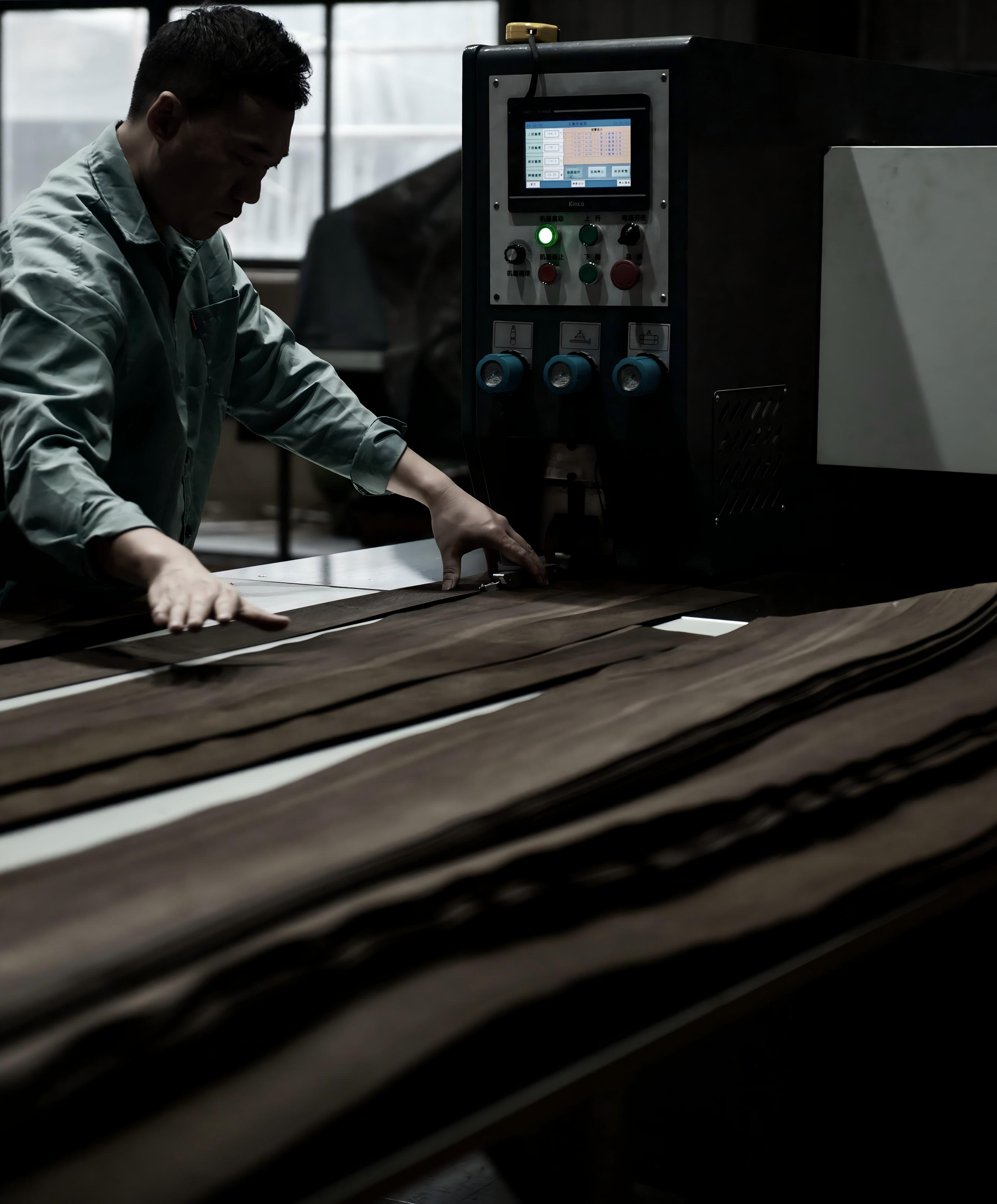
The assembled veneer face is one part of a panel. The manual places veneer joining, gluing and pressing, conditioning, and sanding within panel production, with further work required to create the final object. This distinction matters: a successful pattern layout does not by itself define the supporting board, back construction, edge treatment or coating. Those decisions must fit the intended furniture or interior application. [1]
Finish can also reveal differences between adjacent leaves. Columbia Forest Products explains that the alternating light and dark appearance sometimes seen in book-matched veneer can arise from differences between its tight and loose sides, especially after finishing. This is a specific example of why apparent contrast should not automatically be attributed to different stains. Review the proposed assembled and finished face under the lighting intended for the room. [5]
From a furniture detail to a brand interior
On a wardrobe or sideboard, a modest repeat can make several doors read as a related group. The pattern needs to respect the opening lines so that it remains coherent when the doors are closed. A plain frame can give the composition a clear limit and create a transition to a differently oriented side panel.
In a boutique, consider a patterned display plinth as a concentrated material accent beneath a product, with quieter surfaces nearby. In a hotel, a reception front can give a geometric motif more room to develop. These are different viewing conditions: the first is read around an object, while the second is often seen across a room. Scale the motif for that encounter instead of simply enlarging the same artwork.
Developing a veneer inlay direction with KOSEE
A useful starting point is a clear design intention: directional movement, a steady repeat or a single focal point. Combine it with a drawing of the complete furniture face and a few material references. That gives the pattern a purpose before details multiply.
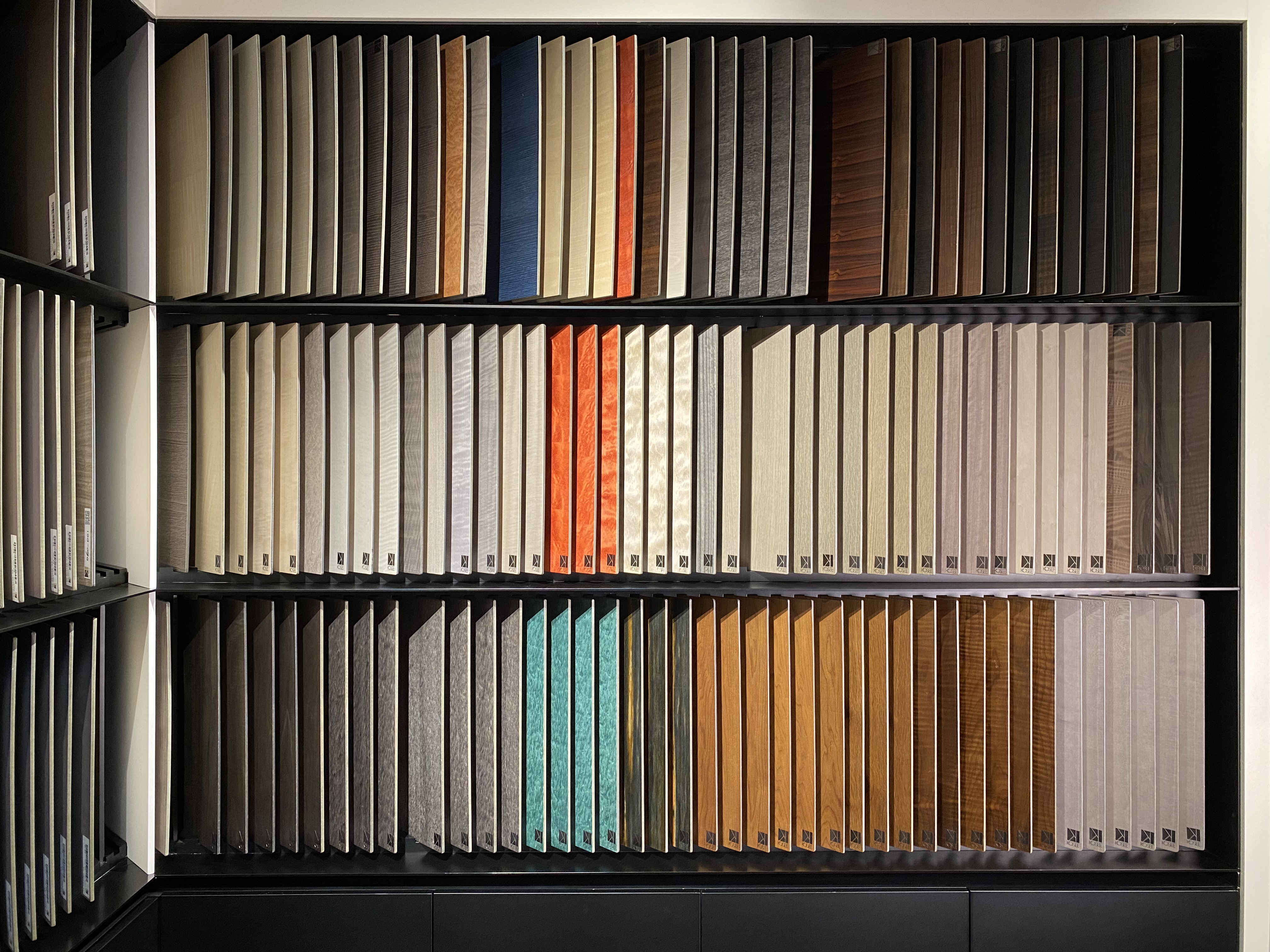
KOSEE's material library and capabilities pages provide starting points for natural, dyed and smoked veneer, geometric inlay and custom artwork development. Share the application, pattern direction and grain character you are exploring to discuss suitable materials and a representative sample. The aim is a decorative surface in which the wood and the geometry support the same design idea. [2, 6]
Explore KOSEE materials and samples
View KOSEE manufacturing capabilities
Browse KOSEE catalogs and material resources